

Starting a trade business in Australia offers independence, strong earning potential, and the satisfaction of building something from the ground up. Whether you are a sparky, plumber, carpenter, or landscaper, taking the leap from subcontractor or employee to business owner is an exciting milestone.
However, running a successful trade operation requires a completely different skill set than mastering the trade itself. Many high-earning tradies find themselves struggling with cash flow, unexpected tax bills, or stagnant growth simply because they fell into predictable financial mistakes during their first few years.
By understanding these early financial traps and putting solid systems in place from day one, you can protect your profits, reduce your stress, and build a trade business that lasts.
1. Mixing Personal and Business Cash Flow
One of the most common mistakes new tradies make is using one bank account for both personal and business expenses. When payment comes in, it may look like profit, but it also needs to cover materials, fuel, insurance, super, and tax. Mixing personal and business spending makes it difficult to track cash flow and know your true profit.
How to Fix It
- Open Dedicated Accounts: Establish separate bank accounts for your business, at a minimum, one for daily operations, one for tax/GST retention, and one for superannuation.
- Pay Yourself a Wage: Set up a consistent, realistic drawing or wage for yourself. Transfer this fixed amount to your personal account on a set schedule rather than withdrawing lump sums whenever you need cash.
2. Neglecting Invoicing and Cash Flow Management
You can complete a job flawlessly, but if you do not invoice promptly or follow up on unpaid bills, your business will quickly stall. Delayed invoicing delays your cash inflow, leaving you vulnerable when material suppliers or subcontractors expect payment.
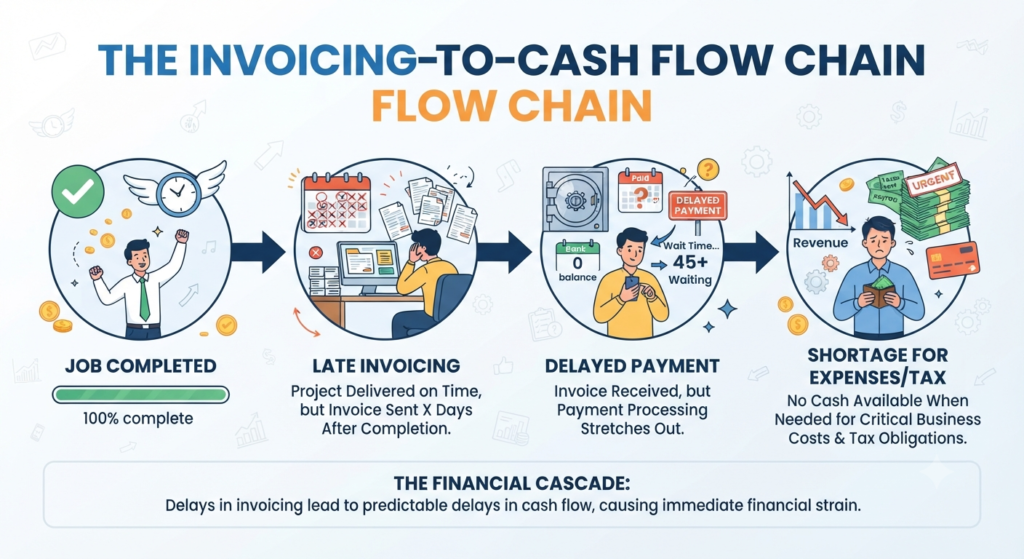
The Real Cost of Delayed Invoicing
| Issue | Immediate Impact | Long-Term Consequence |
| Delayed Invoicing | Slow cash inflow | Inability to pay suppliers on time |
| No Payment Terms | Clients drag out payments | Severe cash flow bottlenecks |
| Unchecked Overdue Bills | Bad debts mount up | Lost revenue and high stress |
Implementing automated invoicing software allows you to send quotes and invoices directly from your phone while still on the job site. If managing invoices, tracking accounts receivable, and keeping payments up to date becomes overwhelming alongside manual work, partnering with professional bookkeeping services Sydney can ensure your records remain accurate and cash continues flowing steadily.
3. Ignoring Tax, GST, and Super Obligations
The Australian Taxation Office (ATO) requires businesses to stay compliant with Goods and Services Tax (GST), Pay As You Go (PAYG) withholding, and Superannuation Guarantee (SG) obligations. A common mistake among new tradies is treating all incoming payments as available income without setting aside the GST portion or preparing for quarterly Business Activity Statements (BAS).
When BAS lodgment or the end-of-year tax bill arrives, many business owners find themselves short on funds. This often forces them to rely on costly short-term loans or negotiate payment plans with the ATO to meet their tax obligations.
Essential Rules for Tax Safety
- Plan for Super: Superannuation is non-negotiable, especially once you begin hiring apprentices or subbies. Setting aside super contributions regularly prevents massive quarterly surprises.
- Park GST Immediately: Every time a client pays an invoice, transfer the 10% GST portion directly into a separate tax savings account.
4. Underpricing Jobs and Ignoring Overhead Costs
Pricing a job purely on an hourly rate or matching a competitor’s quote is a dangerous strategy. Many trade business owners calculate their price based solely on labor and materials, forgetting the unseen overhead costs that silently erode profit margins.
Unseen Costs to Factor Into Your Pricing
- Vehicle Expenses: Fuel, servicing, registration, and insurance.
- Tools and Equipment: Maintenance, replacements, and wear-and-tear.
- Administrative Overhead: Software subscriptions, phone bills, licenses, and insurance.
- Non-Billable Time: Time spent quoting, traveling between sites, picking up materials, and doing paperwork.
To price for true profitability, calculate your total annual overhead costs and divide them across your billable hours. Your charge-out rate must cover your overheads, your wage, and leave a clear profit margin for business reinvestment.
5. Scaling Too Fast Without Proper Financial Infrastructure
Winning larger commercial contracts or taking on multiple projects simultaneously feels like progress. However, rapid expansion requires significant upfront working capital to fund materials, wage runs, and extra machinery before the first progress payment arrives.
Taking on employees or subcontractors without structured payroll processes can quickly lead to errors, compliance breaches, and administrative chaos. For growing trade businesses, setting up reliable small company payroll systems ensures staff are paid accurately, entitlements are calculated correctly, and single-touch payroll (STP) rules are fully met.
Before scaling up your team or taking on larger contracts, ensure your working capital is strong enough to handle delayed payments without threatening your core operations. Seeking advice on business structure, risk management, and cash flow planning through tailored accounting services gives you the stability needed to grow sustainably.
Summary Checklist for Tradie Financial Health
- Separate Accounts: Keep personal and business money strictly apart.
- Automate Billing: Invoice immediately upon job completion and enforce clear payment terms.
- Quarantine Taxes: Reserve GST and tax obligations in a high-interest business sub-account.
- Price for Profit: Factor all indirect overheads and non-billable hours into your rates.
- Get Systemized: Establish clear accounting, payroll, and bookkeeping habits early.
FAQ
The single biggest mistake is treating business revenue as personal income without setting aside funds for GST, income tax, and overhead expenses. This creates severe cash flow issues when quarterly BAS payments or annual tax bills are due.
A good rule of thumb is to set aside 25% to 30% of your total gross income into a separate tax account. This covers your GST obligations, individual income tax, and potential Medicare levies, ensuring you are never caught unprepared.
Many tradies start as sole traders due to simplicity, but transitioning to a company structure often becomes beneficial as net income grows, asset protection becomes critical, or when hiring staff and taking on higher-risk contracts. Consulting a registered tax agent helps determine the right time for your specific situation.