

In the financial and accounting industry, precision is non-negotiable. A single misplaced decimal point, missed tax deadline, or misclassified transaction can result in significant financial losses for a client. When mistakes occur, clients may hold financial professionals accountable for the damages. This is where Errors and Omissions (E&O) insurance becomes essential.
Whether you manage an established accounting firm or work as an independent financial consultant, understanding E&O insurance is crucial for effective risk management and long-term business protection.
What Is Errors and Omissions (E&O) Cover?
Errors and Omissions insurance, often referred to as Professional Indemnity insurance, is a specialized policy designed to protect advice-based businesses. It covers claims made by clients alleging negligence, financial loss, misrepresentation, or inaccurate work.
Unlike general liability insurance, which covers physical injuries or property damage, E&O specifically addresses intangible financial harm caused by professional service errors.
Common Scenarios Covered by E&O Policies
Financial practitioners face diverse risks depending on their day-to-day operations. Key areas where E&O policies provide a safety net include:
- Reporting Inaccuracies: Entering wrong numerical values in balance sheets or income statements that lead to flawed investment decisions or tax penalties.
- Omission of Critical Data: Failing to report key liabilities or tax obligations, causing clients unexpected regulatory fees.
- Bad Financial Advice: Giving guidance that leads directly to client capital loss without proper disclosure of risks.
- Missed Compliance Deadlines: Delaying statutory filings or tax lodge dates, leading to government fines for the client.
Why Financial Professionals and Bookkeepers Need E&O Insurance
Clients trust financial professionals with the core engine of their business: their money. However, even the most meticulous professionals can make an honest mistake during high-volume tax seasons or complex restructurings.
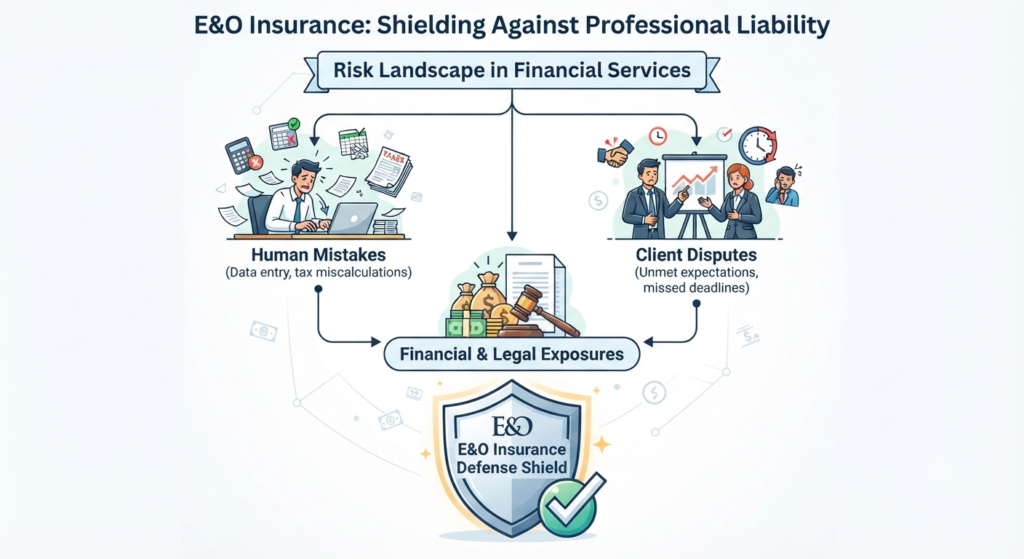
Here is how specialized coverage safeguards modern financial practitioners:
1. Legal Defense Cost Protection
Lawsuits are expensive regardless of guilt. E&O insurance covers defense costs, legal fees, court appearances, and expert witness expenses. Without coverage, a lengthy court battle could drain a firm’s operational cash reserves.
2. Settlement and Judgment Support
If an investigation determines that a professional mistake caused financial loss, the court or arbitration panel may order compensation. An E&O policy funds these settlements up to the agreed policy limit.
3. Credibility and Contract Compliance
Many corporate clients require independent contractors and external agencies to show proof of professional coverage before signing contracts. Holding comprehensive bookkeeper insurance demonstrates business maturity and risk awareness, making it easier to win enterprise accounts.
E&O vs. General Liability: Understanding the Difference
Many business owners make the mistake of assuming that standard business liability insurance covers all risks. The comparison below clarifies the distinction:
| Feature | General Liability Insurance | Errors & Omissions (E&O) Insurance |
| Primary Scope | Physical harm, property damage, advertising injury. | Financial losses caused by professional services or advice. |
| Trigger Event | A client trips over a cable in your office. | An error in financial reports leads to a tax audit penalty. |
| Key Benefit | Covers bodily injury and property claims. | Covers legal defense, settlements, and negligence claims. |
| Target Audience | Almost all brick-and-mortar businesses. | Service providers, financial advisors, and accountants. |
How to Determine the Right E&O Coverage Level
Selecting an appropriate policy limit requires assessing your risk exposure rather than opting for the cheapest entry-level premium. Consider these practical evaluation metrics:
Client Portfolio Size and Deal Value
Look at your largest accounts. If a major accounting error could cost your top client $500,000 in regulatory fines or operational losses, your policy limit must comfortably exceed that threshold.
Industry Regulatory Standards
Regional financial regulations frequently mandate minimum indemnity coverage levels. Practitioners serving commercial districts like bookkeeping North Sydney or regional hubs like bookkeeping Parramatta must align their risk coverage with local statutory guidelines and client expectations.
Scope of Services Provided
Basic record-keeping carries lower liability risk than high-stakes financial auditing, corporate restructuring, or tax planning. Tailor your policy limits directly to the risk level of your core service suite.
FAQ
No. E&O policies specifically cover honest errors, miscalculations, and accidental oversights. Intentional dishonesty, criminal acts, employee theft, and fraudulent activity are excluded from coverage.
In finance, the terms are practically identical. “Errors and Omissions” is more commonly used in North America, while “Professional Indemnity” is the standard term in Australia and the UK. Both address claims arising from professional advice and service failures.
Standard policies operate on a “claims-made” basis, meaning they cover claims filed while the policy is active for work performed after a specific “retroactive date.” To ensure past work remains covered, verify that your policy includes an appropriate retroactive start date.
Premiums vary based on annual business revenue, the complexity of services offered, past claim history, and selected policy limits. A sole practitioner will pay significantly less than an enterprise accounting firm managing multimillion-dollar portfolios.