

Hiring your first employee is exciting. Paying them correctly is where many owners feel nervous. You must report wages to the ATO, pay super on time, withhold tax, and follow the right award. This guide offers single touch payroll explained in plain English, and it shows you how to do payroll for the first time without costly mistakes.

- STP sends wages, PAYG withholding and super data to the ATO every time you pay staff.
- Finalise your STP data by 14 July so employees can see their income statements in myGov.
- Since 1 July 2026, super must reach each employee’s fund within 7 business days of payday.
- The super guarantee rate is 12% of qualifying earnings.
- Award rates usually change on 1 July, so review pay rates every year.
Single Touch Payroll Explained
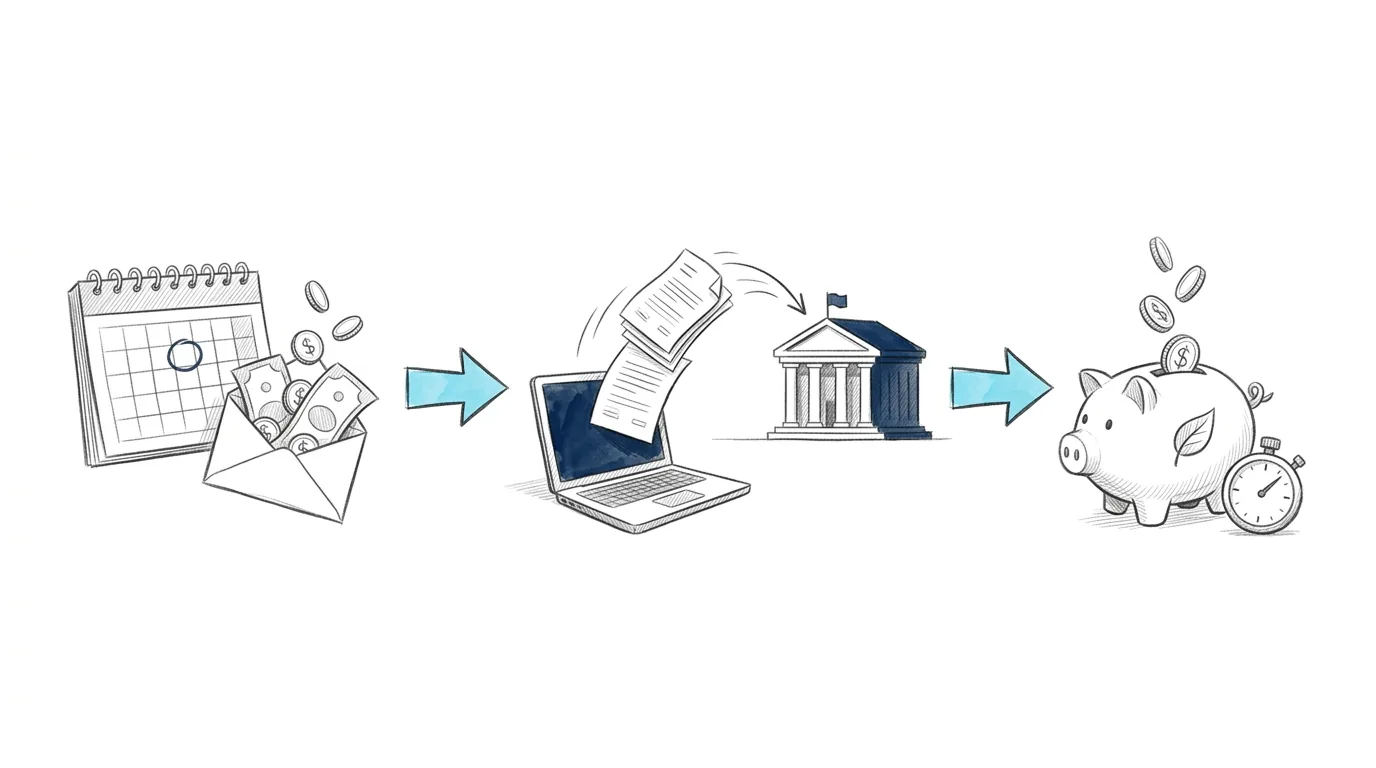
Single Touch Payroll (STP) is the ATO’s system for reporting payroll data. Each time you pay your employees, your payroll software sends the ATO a report. That report covers wages, PAYG withholding and super contributions.
Every employer with staff must report through STP. You no longer prepare end-of-year payment summaries for your team. Instead, your software lodges the data on or before each payday.
At the end of the financial year, you must finalise your STP data by 14 July. Your employees then see their income statements in myGov. If you skip finalisation, your staff cannot lodge their tax returns with confidence.
How to Do Payroll for the First Time
First-time payroll feels complex, but a clear checklist keeps it simple. Follow these steps before your first pay run:
- Register for PAYG withholding with the ATO.
- Choose STP-enabled payroll software.
- Collect each employee’s tax file number declaration and super fund details.
- Confirm the correct award, pay rate and employment type.
- Run your first pay, then lodge your STP report.
Many owners choose expert help at this stage, since early errors tend to repeat every pay cycle. If you want a safe start, specialist payroll services in Australia can set up your system correctly from day one.
Super, PAYG Withholding, Awards and Leave
Four obligations sit behind every pay run. Each one carries its own rules and deadlines.
Superannuation Guarantee
You must pay super for eligible employees on top of their wages. The current rate is 12% of qualifying earnings. Under Payday Super, which started on 1 July 2026, super must reach the employee’s fund within 7 business days of each payday. A new employee’s first contribution has a 20 business day window. A late quarterly habit no longer works.
PAYG Withholding
You withhold tax from each pay and send it to the ATO. The amount depends on the employee’s earnings and tax declaration. Your payroll software calculates it, but you must enter accurate details.
Award Rates
Most employees fall under a modern award or enterprise agreement. Awards set minimum pay, penalty rates, overtime and allowances. Fair Work updates these rates each year, usually from 1 July.
Leave Entitlements
Full-time and part-time employees accrue annual leave and personal/carer’s leave. Casual employees receive a loading instead of paid leave. When someone leaves, you must also pay out their accrued leave.
Payroll Obligations at a Glance
| Obligation | What You Must Do | Key Timing |
|---|---|---|
| STP reporting | Send payroll data to the ATO | With every pay run |
| STP finalisation | Confirm year-end figures | By 14 July |
| Superannuation | Pay super to each employee’s fund | Received within 7 business days of each payday (Payday Super) |
| PAYG withholding | Withhold tax and remit to the ATO | Per your BAS or PAYG cycle |
| Award compliance | Pay correct rates and penalties | Review each 1 July |
| Leave | Accrue and pay out entitlements | Ongoing and on termination |
When to Outsource Payroll
You can run payroll yourself with two or three staff. However, the workload grows quickly. Watch for these signs that you should outsource:
- You spend hours each week on pay runs instead of your business.
- Your staff work varied shifts, so penalty rates confuse you.
- You missed a super payment or an STP deadline.
- You plan to hire more people soon.
Outsourcing hands the technical work to a registered professional. Dedicated support for payroll for small businesses keeps your pay runs accurate and your reporting on time. You keep control of your team, while an expert handles the rules.
How Bundled Payroll and Bookkeeping Reduce Errors
Payroll and bookkeeping share the same numbers. Wages, super and withheld tax all appear in your accounts. When two different providers handle them, data often falls out of sync.
A single team removes that gap. Your bookkeeper reconciles payroll liabilities as they arise, so your BAS matches your STP reports. As a result, you catch mistakes before the ATO does, and you avoid penalties and interest.
Integrated payroll and bookkeeping services also give you one point of contact. You save time, you see your true labour costs, and you stay ready for tax time.
Start Your First Payroll With Confidence
Our team sets up STP-enabled payroll, checks your award rates and keeps super inside the Payday Super window. We work with businesses across Sydney from our North Strathfield and Liverpool offices.
Frequently Asked Questions
What is Single Touch Payroll in simple terms?
STP means your payroll software reports wages, tax and super to the ATO every time you pay staff. It replaces the old end-of-year payment summaries.
Do I need STP if I only have one employee?
Yes. Every employer with employees must report through STP, including small businesses with a single staff member.
What happens if I pay super late?
You may owe the Superannuation Guarantee Charge (SGC). Under Payday Super, it includes the unpaid super, notional earnings (interest) and an administrative uplift of up to 60%. The SGC itself is now tax deductible, but interest and penalties applied after the ATO assessment are not. Paying on time is far cheaper.
When do I need to finalise my STP data?
You must finalise your STP data by 14 July after the end of each financial year. Finalisation marks each employee’s income statement as tax ready in myGov.
Can I run STP through Xero?
Yes. Xero Payroll is STP-enabled and reports each pay run to the ATO. As a Xero Silver Partner, Numerix can set up your payroll, employee records and super payments correctly from the start.